Dead or Alive is NetEnt’s 2009 western cult classic: nine lines, 12 free spins where every Wild sticks, doubled line wins and a top prize of 8,600x the bet.
Dead or Alive
Popular Casinos

€10,000 Welcome Bonus + 20% Cashback

€10,000 Welcome Bonus + 20% Cashback

€3,500 Welcome Bonus + 20% Cashback

€10,000 Welcome Bonus + 20% Cashback

€3,625 Welcome Bonus + 350 Free Spins

€1,000 Welcome Bonus + 300 Free Spins

€5,000 Welcome Bonus + 300 Free Spins

€7,500 Welcome Bonus + 20% Cashback

€2,000 Welcome Bonus + 200 Free Spins

Get €5,000 Casino Bonus + 300 Free Spins
Game Information
Show More
Provider
netent
Type
Slots
Reels
5
Min Bet
0.01
Max Bet
2
Max Win per Spin
56250
Restrictions
GB,NL
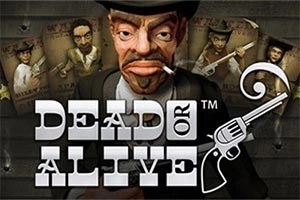



Dead or Alive Slot Review
Dead or Alive is a slot with a reputation, and it earned it. NetEnt’s 2009 western has nine lines, a few dusty outlaws and one feature: 12 free spins in which every Wild that lands stays put until the round ends, and every line win is doubled. That is the whole game, and it is enough to make it one of the most talked-about high-risk slots ever released.
Most bonus rounds are unremarkable. Now and then the sticky Wilds pile up across the reels and the payout climbs towards the game’s 8,600x ceiling. If you are comfortable with long waits for that kind of moment, few classics deliver it so purely.
Dead or Alive at a glance
| Feature | Details |
|---|---|
| Provider | NetEnt |
| Release | November 2009 |
| Layout | 5 reels, 3 rows, 9 paylines |
| RTP | 96.82% |
| Hit frequency | 30% |
| Bet range | €0.09 to €18 per spin |
| Max win | 8,600x the bet |
| Free spins | 12, plus 5 extra with a sticky Wild on every reel |
| Free spins features | Sticky Wilds, line wins doubled |
A small, sparse western
The presentation is modest by modern standards. Wanted posters of outlaws make up the high pays, alongside card values and saloon props for the low pays, all on a wooden frame with a guitar soundtrack. Nothing moves much, and that is part of the charm. The game does not try to distract you from the one thing that matters.
The grid is small, five reels by three rows, with only nine paylines paying from left to right. That narrow structure is a big part of the game’s character. With nine lines there are fewer routes to a win, so dry spells come easily, but each line that connects in free spins counts for a lot.
How the base game behaves
NetEnt lists a 30% hit frequency, which means roughly three spins in ten return something. Many of those returns are smaller than the stake. Regular Wilds help complete lines, but in the base game they do nothing special: they do not stick and they do not multiply.
The scatter pays on its own from two anywhere on the reels, based on your total bet. That gives the base game a small source of extra returns, and it is how you get into the bonus. Three or more scatters at once start free spins.
Honestly, the base game exists to get you to the feature. It is not exciting in itself, and players who need regular entertainment between bonuses tend to drift away. That is not a flaw so much as a design choice: Dead or Alive puts almost all of its excitement in one place.
Sticky Wilds: the heart of the game
Free spins begin with 12 spins at the stake that triggered them. From the first spin, every Wild that lands becomes sticky. It stays in its position for the rest of the round and helps complete wins on every remaining spin. On top of that, all line wins during free spins are doubled.
Why is that so powerful? Each new Wild makes the screen permanently more connected. A Wild on reel three in spin two will still be there in spin twelve, so early Wilds are worth far more than late ones. When two or three Wilds sit on the same lines, ordinary symbols start completing long winning combinations again and again, and the doubled payouts add up quickly.
There is also a small extension. If the sticky Wilds cover every reel, with at least one Wild on each of the five, you receive 5 extra free spins. Getting there is a sign that the round is already going well, so those five extra spins often arrive at the best possible moment.
Following a bonus round spin by spin
It helps to picture how a round unfolds. Say the first two free spins pass with nothing. On spin three a Wild lands in the middle of reel two and sticks. On spin five another appears on reel four. From now on, every spin starts with two fixed Wilds that sit across several of the nine lines, and any outlaw landing on reels one, three and five has a much better chance of completing something. The doubled payouts make even modest lines worthwhile.
Now picture the same two Wilds arriving on spins eleven and twelve. They help on one or two spins at most, and the round ends quietly. The number of Wilds is the same; the timing makes all the difference. That is the most useful thing to understand about Dead or Alive. Early Wilds shape the whole round, late ones rarely do, and you have no way to influence which you get.
Why so many bonus rounds are quiet
The flip side is just as important. Plenty of free spins rounds produce one or two Wilds, often late, often on reels that do not line up usefully. Those rounds can pay less than the stake you spent waiting for them. Because the base game is thin, a run of weak bonuses can feel long and costly.
This is why the game is widely regarded as very high volatility. The 96.82% RTP is generous on paper, but a big share of that return is concentrated in a small number of excellent bonus rounds. Over a short session, you may never see one. Our guides on high-volatility slots and on what RTP actually means explain why both facts can be true at once.
The 8,600x ceiling in context
NetEnt lists the maximum payout as 8,600 times the bet. For a game from 2009 that is a very high figure, and it explains much of Dead or Alive’s appeal among players who like big swings. Reaching anything close requires a free spins round where Wilds land early, cover several reels and keep combining with the top outlaws on multiple lines.
It is worth being realistic about what this means. Such rounds are extremely rare. The ceiling tells you how high the game can go, not what to expect, and most sessions will end far below it.
Stakes and a sensible way to play
The bet range is narrow: from €0.09 to €18 per spin, with nine fixed lines. That low maximum is a reminder of how old the game is, and also of how volatile it was designed to be.
- Play at a stake that gives you several hundred spins. Free spins can take a long time to arrive, and the base game will not carry you.
- Do not treat a weak bonus as a sign that the next one will be better. Every round is independent.
- Decide in advance how much you will spend and stop there, especially after a long dry spell.
- Use the free demo above to see how the bonus behaves before you put money in.
Dead or Alive versus Dead or Alive 2
NetEnt released Dead or Alive 2 in 2019. It keeps the five reels, three rows and nine lines, but offers a choice of three free spins modes with different risk levels, including a version close to the original’s sticky Wild round and much wilder alternatives. It also has far better graphics.
The original is simpler, and some players prefer it for exactly that reason. There is no menu to choose from and no special mode to chase: just twelve spins and the hope that the Wilds land early. If you love the idea of sticky Wilds but want more control over the risk, the sequel is the better game. If you want the classic experience in its rawest form, play this one.
For a western with modern mechanics, Nolimit City’s Deadwood is a much more aggressive alternative. For a calmer NetEnt classic from the same era, Blood Suckers sits at the opposite end of the volatility range. More classics from the studio are on our NetEnt page.
Why it became a cult classic
Dead or Alive arrived at a time when most online slots offered fairly gentle bonus rounds. Its sticky Wild round, with doubled wins and no cap on how well it could go, stood out immediately. Over the years it became a reference point for players and streamers, and many later games borrowed the idea of Wilds that build up over a free spins round.
The game is also a useful reference for understanding newer slots. Whenever a modern release talks about sticky Wilds building up over a bonus, the idea can usually be traced back to rounds like this one. Its staying power says something about good design. The game has one feature, explains it in a sentence, and that feature still creates genuine tension more than fifteen years later.
Dead or Alive pros and cons
What works:
- One of the purest sticky Wild bonuses ever made
- Doubled line wins make good free spins rounds very rewarding
- 96.82% RTP and an 8,600x top prize
- Simple rules that are easy to follow
What doesn’t:
- The base game is thin and often dull
- Many free spins rounds pay little
- Very high volatility needs a solid budget
- Dated graphics and a low maximum bet
Our verdict on Dead or Alive
Dead or Alive is a slot for players who know what they are signing up for. It gives you a sparse base game and a single feature that can be extraordinary or disappointing, with little in between. That focus is exactly why it still has fans. If you want steady entertainment, choose something calmer. If you want the original sticky Wild experience and can live with the swings, it remains a classic worth its reputation.
Play only if you are 18+. Keep your play within limits and see our responsible gambling page for support.
Dead or Alive questions answered

Popular Casinos
€10,000 Welcome Bonus + 20% Cashback
€10,000 Welcome Bonus + 20% Cashback
€3,500 Welcome Bonus + 20% Cashback
€10,000 Welcome Bonus + 20% Cashback
€3,625 Welcome Bonus + 350 Free Spins
€1,000 Welcome Bonus + 300 Free Spins
€5,000 Welcome Bonus + 300 Free Spins
€7,500 Welcome Bonus + 20% Cashback
€2,000 Welcome Bonus + 200 Free Spins
Get €5,000 Casino Bonus + 300 Free Spins
